

Hong Kong Christian Service: From services to workplaces with Promote Harmony
As one of Hong Kong’s major social service organisations, Hong Kong Christian Service (HKCS) holds a clear mission – Promote Harmony (牽引共融) – to lead and connect people towards a more inclusive society. Beyond providing services for children, families, people with disabilities and the elderly, the NGO wants to live out this mission by creating real workplace exposure and internship opportunities through The Hong Kong Jockey Club Community Project Grant: CareER Thriving Grass Career Development Programme (Thriving Grass).
We spoke with Karrie Chan, Deputy Director (Elderly, Rehabilitation & Community), and Alky Cheung, Centre-in-charge of Choi Wan Early Education & Training Centre, to learn more about HKCS’s Diversity and Inclusion (D&I) journey and collaboration with CareER.
📌 How did your organisation begin the D&I journey in Hong Kong? And why did you decide to participate in Thriving Grass?
Within HKCS, we have a committee dedicated to driving our mission in practice, including the value of Promote Harmony. In 2023, we decided that diversity and inclusion — especially in employment — should become a strategic focus after reviewing data and realising that people with disabilities and SEN still face very limited job opportunities.
To respond, we designed CS Inclusive Workplace Work Experience Scheme (CS共融職場工作體驗計劃) so that different service units could host talents with disabilities in short-term roles. Our aim was to mobilise units across the whole organisation, ease supervisors’ worries about unfamiliarity, and provide extra resources so centres would feel ready to participate.
We decided to participate in Thriving Grass because CareER’s mission strongly aligns with ours — both of us want to promote workplace inclusion and unleash the potential of higher-educated talents with disabilities — and we recognised CareER’s expertise. We invited CareER’s Co-founder & CEO Walter to share with our centres’ supervisors, and over 100 unit heads joined the session and were inspired, further encouraging us to connect our internal efforts with Thriving Grass.
📌 What are the takeaways during the process?
Through our top-down leadership, we took the journey seriously by anticipating execution challenges, actively seeking colleagues’ input on their concerns and difficulties, and implementing the plan through internships while providing resources for departments to hire an extra person as the first step for D&I recruitment. We realised initial hesitations stemmed from unfamiliarity rather than real barriers, so we offered knowledge sessions, structured support and resources — which quickly filled our voluntary quota as more units joined. We also learnt that job design matters: crafting realistic yet meaningful roles draw more applications than overly demanding requirements.
Whole-team involvement remains essential. Units nominate mentors and hold regular reflection sessions with interns, transforming placements into shared learning rather than one-way “helping.” This “walking hand-in-hand” mindset fosters mutual growth for all.
Taking our Choi Wan centre as an example, we hosted a part-time activity assistant with hearing impairment who wears hearing aids. We made some simple but thoughtful adjustments, such as speaking to her face-to-face instead of from behind, staying mindful of background noise in the workplace, and sometimes using written notes to record tasks or reminders like preparing group materials. Once colleagues became used to this communication style, day-to-day collaboration ran smoothly, and many of us felt there was little difference between her and any other team member. Her calm manner and bright smile quickly won over children and parents, and her initiative—volunteering for busy events, joining activities and even returning as a volunteer after the placement—made us feel she had truly become part of our team.
📌 Any feedback on CareER after the Thriving Grass Programme? Will there be any next steps?
For us, CareER has been a close and responsive partner throughout the process. To begin with, the CareER team supported us on two rounds of training for supervisors and mentors on disability awareness and practical communication preparation for our team, giving colleagues greater psychological readiness and easing anxiety about the unknown. Since then, CareER supported us in hiring 8 disability/SEN candidates in 2024; and 13 in 2025 respectively, five of which converted from internships into part-time or full-time renewable contracts. Given the success in the past two years, we are planning to hire another 10 CareER members in 2026. Throughout the internships, CareER provided close follow-up, regularly checking in with both unit heads and interns to identify challenges and co-create solutions. We appreciate that they actively listen to both sides and help align expectations, making the collaboration feel like a genuine partnership, rather than a one-off candidate referral.
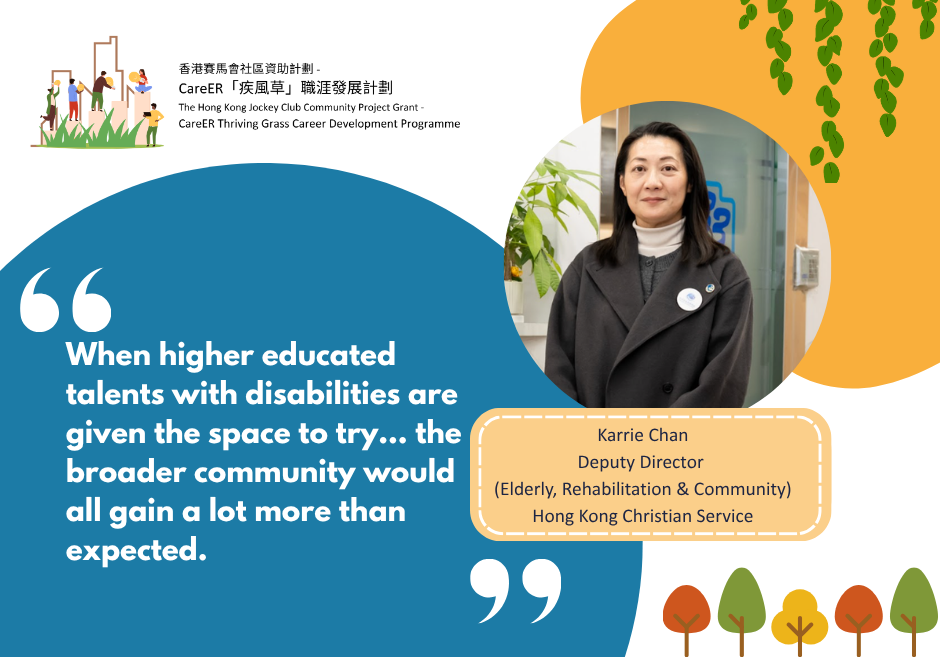
Looking ahead, we look forward to deepen and sustain our D&I journey with CareER. Internally, we plan to continue expanding the CS Inclusive Workplace Work Experience Scheme, building on the positive experiences of early-adopter units and mentors. Of course, we also want to encourage more NGOs and social service organisations to join this D&I journey. It is not just about “helping others” one-sidedly but about mutual learning and growth. When higher-educated talents with disabilities are given the space to try, open up and seize opportunities, all stakeholders including our teams, service users and the broader community would all gain a lot more than expected.